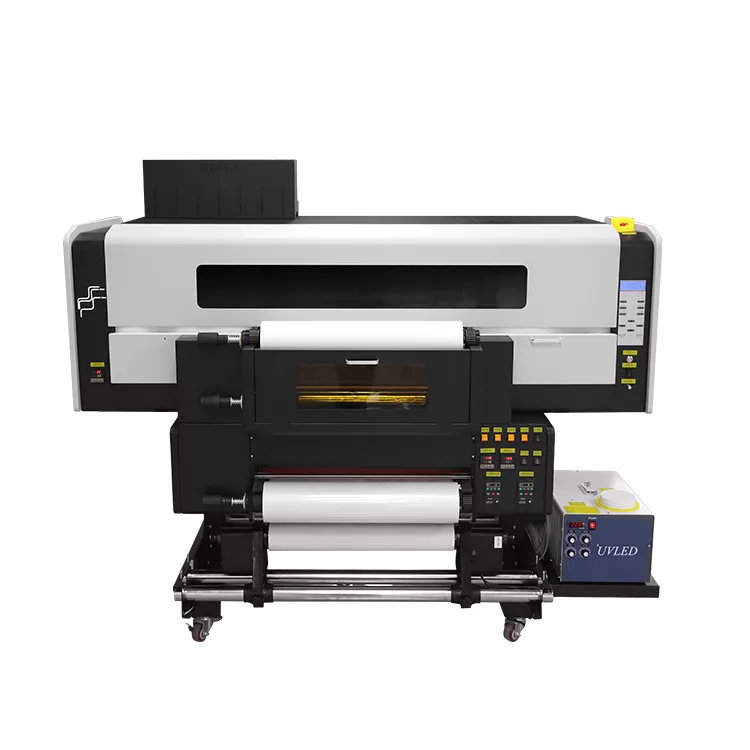
Choosing commercial printing equipment requires more than comparing purchase prices. Businesses must consider production volume, print width, finishing requirements, automation, and the types of customers they serve. For companies producing custom labels, promotional merchandise, and premium packaging, the right UV DTF system can improve workflow efficiency while expanding product options. Comparing available models by their intended applications helps buyers identify equipment that fits current demand and future growth.
What Makes Commercial UV DTF Printers Different?
UV DTF printing creates decorative transfers on film using UV-curable inks. The finished transfer can then be applied to compatible surfaces, including selected glass, acrylic, metal, and plastic products. This approach allows businesses to prepare designs separately from the objects being decorated, which can simplify customization across different product shapes.
However, commercial machines differ in working width, printhead configuration, production speed, and finishing capabilities. A UV DTF printer manufacturer should provide clear specifications so buyers can compare equipment based on measurable requirements rather than promotional claims alone.
Comparing Leading Xinflying Models
Xinflying offers several UV DTF configurations for different production needs. The following comparison highlights the practical differences between its standard printing, dimensional-effect, and gold-stamping solutions.
XF-420ST: Gold Stamping for Mid-Scale Businesses
The XF-420ST is designed for businesses seeking metallic decoration without moving immediately to a wider industrial machine. Xinflying lists a 16.5-inch printing width, four Epson i1600-U1 printheads, and 8-pass productivity of 3.5 m²/h for this model.
Its integrated gold-stamping capability suits boutique packaging, customized gifts, and premium labels. Businesses with moderate order volumes can evaluate this format when metallic finishes are important but a 24-inch production system may exceed their immediate requirements.
XF-600: Standard Wide-Format Commercial Printing
For businesses prioritizing general-purpose UV DTF production, the XF-600 provides a wider working format. Xinflying lists a 24-inch print width and three Epson i3200-U1 printheads.
This configuration is worth evaluating for companies producing regular transfer orders across multiple customer accounts. Compared with a specialty stamping system, a standard configuration may be more appropriate when the primary requirement is full-color output rather than integrated metallic finishing. Buyers should confirm the current production-speed specifications and included accessories before making a direct cost comparison.
XF-600S: Adding Simulated Embroidery Effects
The XF-600S combines UV DTF printing with simulated embroidery effects to create raised decorative textures without traditional stitching. It features three Epson i3200-U1 printheads and a 24-inch printing width.
This model may suit promotional merchandise suppliers, personalized gift businesses, and branding companies that want to differentiate their offerings through dimensional-looking graphics. Buyers should assess sample quality, artwork requirements, and the suitability of the effect for their target products before committing to large orders.
XF-600ST: Integrated Gold Stamping for Premium Production
The XF-600ST combines full-color UV DTF printing with gold foil stamping in an automated workflow. Its specifications include four Epson i3200-U1 printheads, a 24-inch printing width, and listed 6-pass productivity of 5.5 m²/h.
Printing, foil transfer, waste discharge, and laminating are integrated into one process. The system also includes a large-capacity ink supply with stirring and low-ink alerts, water-cooled UV curing lamps, and intelligent bottom heating.
These features make the XF-600ST a strong candidate for luxury labels, premium packaging, and high-end customized gifts. Businesses should verify output quality and actual throughput using representative production jobs.
How to Compare a UV DTF Printer for Sale
Match Printing Width to Order Requirements
A wider machine can accommodate larger layouts and potentially fit more designs across the film. However, actual productivity depends on artwork arrangement, print settings, and finishing time. Buyers should calculate expected output using their typical jobs rather than print width alone.
Evaluate Automation and Running Costs
Integrated finishing can reduce manual handling between production stages. Nevertheless, automation should be assessed alongside consumable prices, maintenance requirements, operator training, and technical support.
When evaluating a UV DTF printer for sale, businesses should request a complete quotation covering the machine, software, compatible inks, films, foil where applicable, installation, warranty, and spare parts. These costs provide a more realistic basis for comparing suppliers.
Confirm Technical Support and Application Suitability
A dependable UV DTF printer manufacturer should offer accessible technical documentation and support for installation, maintenance, and troubleshooting. Buyers should also test adhesion and finish on their intended substrates because surface coatings and material composition can affect application results.
Make the Investment Fit the Business Strategy
The best model depends on the products a business intends to sell. The XF-420ST suits buyers exploring integrated gold stamping at a smaller format, while the XF-600 supports wider-format standard production. The XF-600S targets distinctive raised effects, and the XF-600ST combines wide-format printing with automated metallic finishing.
Before purchasing a UV DTF printer for sale, businesses should compare verified specifications, sample quality, total operating costs, and supplier support. By matching equipment capabilities to real customer demand, buyers can choose a practical production solution and scale their printing operations with greater confidence.
