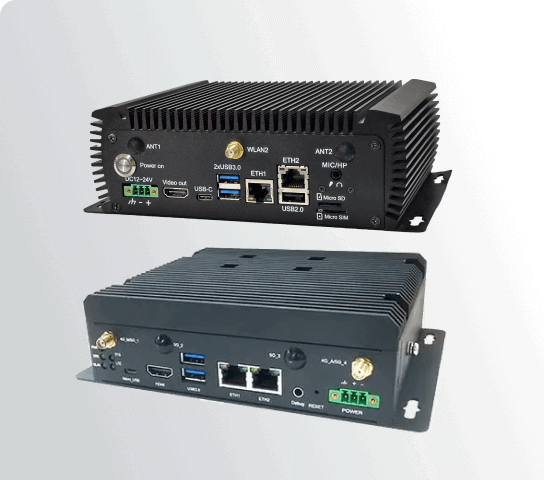
Engineers developing automation equipment and intelligent systems must consider how computing resources should be integrated into the overall architecture. Embedded PCs and industrial PCs may share similar industrial characteristics, but they are designed to address different system requirements, from machine integration to flexible standalone computing.
An industrial PC is typically designed as a more general-purpose computing platform that provides strong processing capability, expansion flexibility, and support for a wide range of software applications. An embedded PC is designed to become part of a specific device or system, combining computing resources with compact integration and application-focused functionality.
Understanding the difference helps engineers avoid selecting hardware based only on performance specifications. The right choice depends on how the computer will operate, where it will be installed, and what role it must perform inside the equipment.
The Difference Starts With Where Computing Fits Into the System
The main difference between an embedded PC and an industrial PC comes from their intended position within a system design.
Industrial PCs are often used as independent computing units. They may be installed in control cabinets, production stations, or equipment rooms where operators interact with the system directly. Their architecture usually prioritizes computing flexibility, storage options, and compatibility with industrial software.
Embedded PCs, on the other hand, are integrated into the equipment itself. They serve as a dedicated computing layer that manages specific tasks such as machine control, data processing, communication, and edge AI functions.
This distinction has become increasingly important as industrial equipment becomes more intelligent. Modern machines are expected to collect sensor data, analyze information locally, and communicate with other systems without depending entirely on centralized computing resources.
An Industrial Embedded Computer is designed for these equipment-level requirements. It combines processing capability with industrial interfaces and compact designs suitable for long-term deployment. Vantron provides embedded industrial computing platforms designed for edge applications, automation systems, and intelligent equipment scenarios.
Industrial PCs Support Flexible Computing Environments
Industrial PCs are commonly selected when engineers need a powerful and adaptable computing environment. They are suitable for applications where software flexibility and processing capability are higher priorities than compact integration.
Manufacturing plants often use industrial PCs for tasks such as production monitoring, database management, industrial visualization, and centralized machine coordination. These systems can support larger software stacks and connect with multiple industrial devices.
An industrial PC may also be preferred when future expansion requirements are uncertain. Additional storage, communication cards, or processing modules can often be added as application requirements change.
However, this flexibility can come with design trade-offs. Systems that rely on separate computing units may require more installation space, additional wiring, and more complex integration with equipment.
For fixed-location applications such as factory control stations or engineering workstations, these characteristics may be acceptable. The challenge appears when computing must move closer to the machine or operate in a limited physical space.
Embedded PCs Are Designed Around Equipment Integration
Embedded PCs are developed with a different engineering objective: making computing an integrated part of the product.
Smart equipment increasingly requires local intelligence. Robotics systems need real-time processing for movement decisions. Vision inspection machines need image analysis close to cameras. Industrial gateways must collect and process data from connected devices.
An industrial embedded pc supports these scenarios by placing computing resources directly inside the equipment. This reduces dependency on external systems and enables faster responses at the edge.
Vantron’s embedded industrial computers include compact computing platforms, edge AI systems, and application-focused hardware designed for industrial deployments. Their product portfolio supports ARM and x86 architectures, allowing engineers to select platforms according to performance, power, and software requirements.
Processor ecosystem choices also influence embedded designs. Processor selection also influences embedded designs, with different processor architectures offering different balances of performance, power efficiency, software compatibility, and integration flexibility.
Engineers Should Evaluate the Hardware Role Before Choosing a Platform
The choice between embedded and industrial computing should begin with the function the computer performs inside the system.
If the computer acts as a central workstation, handles complex software applications, or requires frequent user interaction, an industrial PC may provide the necessary flexibility.
If the computer becomes part of a machine, vehicle, robot, or intelligent device, an embedded approach is often more suitable. Engineers must consider installation space, power requirements, communication interfaces, environmental conditions, and long-term maintenance needs.
For example, autonomous vehicles require onboard processing, communication, and sensor integration. A vehicle AI PC must operate within a mobile environment where size, power efficiency, and connectivity are critical factors.
Industrial automation provides another example. A robotic system may require local AI inference, motion coordination, and communication with factory networks. A dedicated embedded computer can simplify this architecture by combining multiple functions into one platform.
The selection process should also consider lifecycle requirements. Equipment manufacturers often design products that remain deployed for many years, making hardware stability and platform availability important factors.
The Future of Industrial Computing Favors Purpose-Built Platforms
The difference between embedded PCs and industrial PCs is becoming clearer as industrial systems evolve. Both approaches remain valuable, but they address different engineering challenges.
Industrial PCs continue to provide advantages for flexible, high-performance computing environments. Embedded PCs are increasingly becoming the foundation for intelligent equipment that requires integrated, reliable, and application-specific computing.
In many industrial deployments, computing hardware is no longer treated as a separate component but as part of the machine architecture itself. Vantron’s embedded computing platforms are designed for scenarios where automation systems, edge intelligence, and connected devices require stable processing close to the point of operation.
The selection between an Industrial Embedded Computer and other industrial computing options ultimately comes down to how the hardware fits into the equipment design. For applications that require compact integration, continuous operation, and local data processing, an industrial embedded pc provides a practical foundation for building smarter and more adaptable industrial systems.
