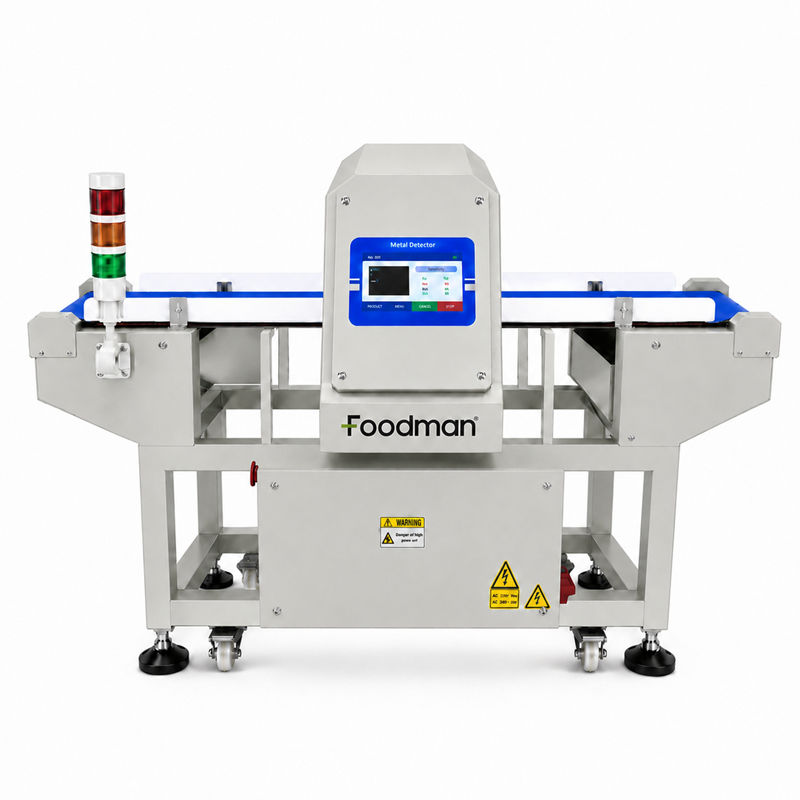
Food manufacturers need to detect foreign objects without opening packages or stopping production for manual inspection. X-ray technology addresses this problem by examining differences in how materials absorb X-rays as products pass through an inspection system. A modern X-ray food inspection process therefore works as an inline sequence: the product enters the tunnel, X-rays pass through it, detectors capture the resulting image, software analyzes the image, and a rejection mechanism removes products identified as contaminated.
What Happens When Food Enters the Inspection Tunnel
The process begins as products move along a conveyor or through a dedicated inspection arrangement. An X-ray tube generates radiation that passes through the product. Different materials absorb different amounts of X-ray energy, creating variations that the detector can record.
Foodman describes its X-ray systems as using penetration technology to detect metal, non-metallic contaminants, and other high-density materials. This principle makes inspection possible even when the suspected foreign object is enclosed inside packaging.
The detector converts the transmitted X-rays into an image. Instead of relying on the visible appearance of the package, the system evaluates what is happening inside it. That distinction is particularly useful for sealed products where opening every package would be impractical.
How Density Differences Create the Inspection Image
The central mechanism is material density. Dense substances generally absorb more X-ray energy than less dense food materials. Consequently, foreign objects such as metal, glass, stones, ceramics, and certain plastics can create detectable contrasts within the image.
A food X-ray inspection system does not simply look for one fixed visual shape. Image-processing software examines patterns within the captured image and compares them with the expected characteristics of the product. Foodman states that its systems use image-processing technology and AI-based algorithms to improve foreign-object detection.
Product composition can influence this process. A thick or dense food product may create a more complex image than a lightweight product. Packaging material can also affect the image. For that reason, inspection settings need to correspond to the actual product being processed rather than relying on a universal configuration.
How Software Separates Contaminants From Food
Capturing an X-ray image is only one part of the operation. The system must interpret the image quickly enough to make a decision while the product continues moving through the line.
Foodman’s technology portfolio includes Foodman Dual‑Energy X‑Ray (FDX), described as a dual-energy X-ray system using high-resolution Time‑Delay Integration (TDI) detectors and deep learning algorithms for material analysis and low-density impurity detection. Its Foodman Intelligent Algorithm Platform (FIAP) applies AI algorithms to image data for foreign-object and defect inspection.
Dual-energy technology can be useful where conventional image contrast is difficult to interpret. Instead of treating every material simply according to its apparent density, the system can analyze material characteristics across different energy levels. The exact suitability depends on the product and the contamination risk being addressed.
Where Detection Fits Into the Production Workflow
Inspection normally takes place while products are already moving through production. That makes equipment configuration important.
Packaged goods may pass through a conveyor-based tunnel after filling or sealing. Foodman Vision‘s FXR-4017, for example, is designed for medium-sized packaged products and multilane applications. Its listed working speed is 10–70 m/min, with a 400 × 170 mm aperture.
Bulk products require a different physical arrangement because loose materials are not contained in individual packages. Systems such as the FXR-S4017 are designed for products including nuts, rice, coffee, grains, and other unpackaged materials. This bulk‑handling model has a listed working speed of 10–100 m/min.
Pipeline inspection creates another workflow. Pumped products such as liquids, pastes, and other flowable foods require inspection without interrupting the product stream. Foodman’s pipeline system uses an automatic three-way rejection valve and is designed for integration with food-processing equipment.
Note: These are nominal model‑specific specifications. Real‑world throughput depends on product characteristics and actual line‑site operating conditions.
Why Different Food Lines Need Different X-Ray Configurations
The inspection principle remains consistent, but the machine architecture changes according to the product.
Large packaged products require a larger inspection aperture. Loose materials may require multi-lane air-blast or flipper rejection. Bottles and cans can benefit from side-scan configurations because the inspection angle can be adapted to the container geometry. Foodman’s product range includes packaged, bulk, canned, poultry and meat, pipeline, and specialized bone-inspection systems.
These differences explain why selecting equipment solely by detector sensitivity can produce a poor fit. Product dimensions, packaging, line orientation, throughput, and rejection method all affect how effectively the inspection process works.
From Detection Signal to Product Rejection
Once software identifies a suspected contaminant, the system must act before the product reaches the next production stage. The timing between detection and rejection is therefore essential.
Depending on the configuration, rejection may involve an air blast, flipper, pusher, alarm, or line‑stop function. The FXR-4017, for example, offers sound and indicator alarms, machine‑stop capability, and configurable rejector options. Bulk models can use multi-lane air-blast or flipper‑style rejection systems.
Effective rejection is more than removing a contaminated item. It should also avoid unnecessarily removing acceptable products. Reliable image analysis and appropriate settings help balance food safety with product yield.
Note: These are configurable options. Actual hardware functions are subject to project‑specific ordering specifications.
Making Inspection Part of Continuous Food Safety Control
An X-ray food inspection system becomes most valuable when detection is integrated into routine production control rather than treated as an isolated checkpoint. Operators can monitor inspection results, manage product settings, and use available data functions to support traceability.
Foodman lists interfaces such as LAN and USB on selected systems, while its product information also describes image management and reporting functions.
Foodman approaches X-ray inspection as a configurable production solution, with systems designed for different product formats and manufacturing environments. The practical objective is to maintain continuous inspection while keeping product flow, rejection, and operational requirements aligned.
The complete X-ray food inspection process can therefore be understood as a chain of coordinated actions: X-rays penetrate the product, detectors capture differences in absorption, software interprets the image, and the control system triggers the appropriate response.
When the equipment configuration matches the food, packaging, and production line, X-ray inspection becomes an integrated layer of foreign-object control rather than simply another machine on the conveyor.
